Wednesday, 24 November 2010

James Sherwood


ARCHIVE
In Autumn 2007, Gieves & Hawkes MD Mark Henderson asked James Sherwood to assist Mr Robert Gieve - fourth and last generation in the family firm - to curate an Archive Room at No 1 Savile Row for the great bespoke tailoring house. Founded in 1785 and 1771, Gieves & Hawkes had impeccable pedigrees as naval and military tailors respectively beginning with iconic customers Admiral Lord Nelson and the Duke of Wellington. Gieves & Hawkes has held the Royal Warrant for every successive monarch from George III in 1809 to the present Queen. It was Mr Robert's life's work to rebuild the Gieves archive that had been decimated first by a direct hit during the Blitz in 1940 and then by an IRA bomb in 1975. Mr Robert's tragic death in November left Sherwood with the task of preparing the Archive Room for public display. It was only after Mr Robert's death that it became clear how many secrets still lay in the vaults underneath No 1; not least the history of Hawkes & Co. Mr Gieve had understandably given precedence to his family and the Royal family. With the keys to the vault underneath No 1, a warehouse full of long neglected uniforms and a war chest to acquire significant antique pieces at auction, Sherwood began piecing the histories of these remarkable firms and their illustrious customers back together. The Archive Room officially opened in May 2008.

The Grand Staircase at No 1 Savile Row, the 'wall of fame', displaying 75 portraits of the companies' famous and infamous customers.Wall of fame portraits including Prince Aly Khan, Sir Michael Caine, President Clinton and David Beckham.

A 1925 Gieves Ltd Aviator's helmet similar to those later worn for the 1933 first flight over Everest.

A panorama of the Gieves & Hawkes Archive Room with the deeds to No 1 Savile Row dating from 1735 displayed in the central glass table.

>HRH Prince of Wales and Lady Camilla visit the archive.

A collection of books published for the Royal Navy by Gieves' own publishing house founded in 1916.

very early Gieves Ltd RAF tunic dated within ten years of the service being founded by HM King George V in 1918.

RAF Director of Music Ceremonial Busby with Ostrich Plume

Hawkes & Co ledgers (some dating back to 1840) with a bundle of complete company accounts dated 1880-1917 in the foreground

A detail of a c.1900 Simpson & Co livery made for the Earl of Dudley's London mansion.

Gieves Ltd 1890 Rear Admiral's Full Dress Tunic and Cocked Hat.

A collection of Royal Naval shoulder plates, belt buckles and buttons found in the vaults at No 1 Savile Row in a tin chest inscribed J B & Co Ltd. Barker was a subsidiary company owned by Gieves Ltd. Swan feather helmet and greatcoat of HM The Queen's Gentlemen-at-Arms tailored by Hawkes & Co and last worn at the funeral of HM King George V1 in 1952.


Monday, 22 November 2010

JAMES FOX

Laura Barton
The Guardian, Thursday 13 March 2008
'I think my journey was to spend a while away from acting' - James Fox. Photograph: David Levene Over water and Polo mints, James Fox recalls shooting the new Harmony Korine film, Mister Lonely, a story about a group of flying nuns in Africa and a commune of celebrity impersonators in the Scottish Highlands. "You've heard about the gnats, of course?" His voice is soft and clipped as an English country lawn. "Extraordinary gnats in Scotland," he says. "We literally had to wear masks just to go and have lunch." Fox, of course, is a senior member of what is often referred to as the Fox Acting Dynasty, a familial sprawl that includes his parents, Robin Fox and Angela Worthington, his brothers Edward and Robert (an actor and a producer respectively), his niece, the actor Emilia Fox, and his son, the actor Laurence Fox (who recently married Billie Pip.
He began acting as a child. "It paid for a bicycle, I seem to remember." And throughout the 1960s, his career was in the ascendant; he won acclaim for his roles in King Rat, Thoroughly Modern Millie, Isadora, and - most famously - Performance, Donald Cammell and Nic Roeg's portrayal of swinging London, in which he starred opposite Mick Jagger and Anita Pallenberg.
After Performance, Fox suffered a nervous breakdown, found God and, to the astonishment of those who saw him as one of the great talents of the age, stopped acting. "It was just part of my journey," he says, placidly.
"I think my journey was to spend a while away from acting. And I never lost contact with it - watching movies, reading about it ... so I didn't feel I missed it."
For all his success, he remembers his 20s as a period of professional uncertainty, with long stretches spent out of work, disappointing stints in theatre, and a couple of unsatisfactory film roles. "I had done Isadora," he says, "and that had been a very difficult experience, I hadn't been very turned on by that. I don't know why - I really wanted to work with [director] Karel Reisz, but I just didn't feel very excited by the way it was turning out."
He worked with other great directors - Roeg, Tony Richardson, Joseph Losey - "and all of those things had been tremendous. But I wasn't thinking, 'What a great time I'm having.' What I would have missed was working on a great project, but there weren't any great projects around at the time I left."
However, Performance was a great project. "I was very excited about it," Fox recalls. "It was flattering, because I'd worked with Cammell before [he wrote the script for Duffy], and he literally said, 'I'm creating this part for you.' Well, after Marlon Brando dropped out, he did. He wrote it with me in mind. And this is the best way to create films between directors and actors. You can see it with Paul Thomas Anderson and Daniel Day-Lewis - you can see the respect, the affection, the sparks that fly."
Then came what Fox refers to as "this conversion experience". "I had a couple of very bad experiences with the theatre," he says. "I actually tried to connect my faith with the theatre, in a production of [TS Eliot's] Murder in the Cathedral in Canterbury. People tried to help me connect my faith with drama, whatever Christian drama there was. They thought maybe I could go that way. But none of those things ever turned me on." Instead, he went to work with an outreach Christian ministry called the Navigators.
In his new film, Fox plays a Pope impersonator, a curious figure who is at once grand and dishevelled, alternately shouting at the sky and sitting in bathtubs in the garden, weeping; it's a part that nods to, and draws upon, Fox's own religious experience. He says his conversion was kindled by "a need, and exposure to a grown-up connection with the scripture, and with other people who seemed to have this reality of God in their daily lives".
He speculates that the Pope character "probably had a very strong religious period and then probably a long period of institution". While the shared religious experience was useful in playing the part, Fox says: "I couldn't project my experience into a Catholic one, because my experience was more in the Protestant church."
Playing the Pope was a strange experience. "Almost immediately, I put the costume on and I decided that he should be Pope John Paul, and that was important, that it was actually that Polish pope. It was a very fruitful and an endlessly interesting, imaginative exercise. And I thought he fitted quite well into the commune. He's clearly a very strange man, but then they all are."
Indeed they are: Korine's imaginary commune includes Madonna, the Queen, Abe Lincoln, Charlie Chaplin, who is married to Marilyn Monroe (played by Samantha Morton), with Shirley Temple for a daughter. They occupy a huge castle, rear sheep and roll about the grounds, united by a common goal to build a theatre so that they might put on a performance for the local villagers. Everything they do - whether it's tai chi in the garden or stand-up routines on their rickety stage - is infused with a sense of melancholy.
Is there any real difference, I ask Fox, between impersonators and actors? "Well," he says, "impersonators take a giant leap away from reality; they just want to deny it altogether. Actors have to cope with reality. The ones I'm fascinated by are the ones who model completely still on [London's] South Bank. Aren't they interesting? Beautiful, aren't they? Funny thing is they can come straight out of it. I saw one of them at the end of the day, just walking away. But I don't think they're lost - this film is about lost people."
The film's sadness appealed to Fox, as did the chance to work with Korine, the 35-year-old director of Gummo and Julien Donkey-Boy. "I liked the script very much; it was very original," he says. "And I heard from my young family, and they knew his work - they said he was a wonderful director with a lot of brilliance."
It also reunited Fox with Anita Pallenberg, his co-star in Performance, this time playing the Queen. "It was lovely," Fox says sweetly. "I had seen her on and off a few times over the years, but we were both projected into the most amusing characters to have to put on."
Naturally, Korine had fun with the Fox-Pallenberg scenes. "Harmony is a master improvisor," Fox smiles. "In some ways, I wish more improvisation had stayed in the film. There was a very nice scene I was involved in with Anita. She was smoking a spliff with Sammy Davis Jr, and the Pope was kind of passed out and snoring and she's talking in this low whisper and ..." He laughs. "Then Harmony had these wonderful lines that he fed to Anita. He'd say, 'You know, before he found God, he used to have such a great body and then he let it go. Just say that to Sammy Davis Jr.' And she would be saying these things and cracking up, and, of course, I couldn't not crack up myself." Sadly this scene didn't make the final cut.
Like all Korine's films, Mister Lonely will no doubt divide audiences: its two narratives never come together, and while the film carries all the weight of a message - musing on the nature of faith and celebrity, society and the individual - it offers little in the way of elucidation.
"I'd like to know," Fox says, "just before we go, just what you felt it was about?" We muddle our way uncertainly through its themes. "Perhaps," he offers, "it's that our showbiz idols have become the icons and the idols of a postreligious Europe, that there has to be something to fill one's need and admiration and faith?"
He adds, hesitantly: "I think that, because people aren't sure who they are, they become very obsessed with who other people are, and want to live vicariously through them. And technology now allows us to do that. Before, we would have had to do that through our imaginations and literature, which is not as harmful. I think it's a film which will define that angst." He looks momentarily puzzled, laughs a little sheepishly, and quietly puts away his Polo


Wednesday, 17 November 2010

HARROW SCHOOL

History
Harrow School, commonly known simply as "Harrow", is an English independent school for boys situated in the town of Harrow, in north-west London. [1] Harrow has educated boys since 1243 but was officially founded by John Lyon under a Royal Charter of Elizabeth I in 1572.

The school has an enrollment of approximately 800 boys spread across twelve boarding houses, all of whom board full time.

Harrow has many traditions and rich history, which includes the use of boaters, morning suits, top hats and canes as uniform as well as a very long line of famous alumni including eight former Prime Ministers (including Winston Churchill, Jawaharlal Nehru and Henry John Temple, 3rd Viscount Palmerston), numerous foreign statesmen, former and current members of both houses of the UK Parliament, two Kings and several other members of various royal families, 19 Victoria Cross holders, and a great many notable figures in both the arts and the sciences. It is one of the original nine English public schools as defined by the Public Schools Act 1868.[5]


Various schools in the same location have educated boys since 1243, but the school in its current state was founded in February 1572 under the Royal Charter granted by Queen Elizabeth I to John Lyon, a local wealthy farmer.[6] In the school's initial charter six original governors were named, including two members of the Gerard family of Flambards, and two members of the Page family of Wembley and Sudbury Court.[7] It was only after the death of Lyon's wife in 1608 that the construction of the first school building began. It was completed in 1615 and remains to this day, however it is now much larger.

The school grew gradually over time but growth became rapid during Imperial times as British prosperity grew.[8] Lyon died in 1592, leaving his assets to two causes, the lesser being the school, and by far the greater beneficiary being the maintenance of a road to London, 10 miles (16 km) away. The school owned and maintained this road for many years following Lyon’s death and the whole school still runs along this 10 mile road in an event called “Long Ducker” every November. At its beginning, the primary subject taught was Latin, and the only sport was archery. Both subjects were compulsory; archery was dropped in 1771.[9] Although most boys were taught for free, their tuition paid for by Lyon's endowment, there were a number of fee-paying "foreigners" (boys from outside the parish). It was their presence that amplified the need for boarding facilities. By 1701 for every local there were two foreign pupils; this was used as a way to generate funds for the school as fees increased. By 1876 the ratio was so high that John Lyon Lower School was brought under the authority of the governors of the Upper School so that the school remained within its charge of providing education for the boys of the parish. It is now known as The John Lyon School and is a prominent independent school in England. It maintains close links with Harrow.[6] The majority of boarding houses were constructed in Victorian times, when the number of boys increased dramatically.


Old SchoolsThe 20th century saw the innovation of a central dining hall, the demolition of small houses and further modernisation of the curriculum. Presently there are approximately 800 boys boarding at Harrow.

In 2005 the school was one of fifty of the country's leading independent schools which were found guilty of running an illegal price-fixing cartel, exposed by The Times, which had allowed them to drive up fees for thousands of parents, although the schools made clear that they had not realised that the change to the law (which had happened only a few months earlier) about the sharing of information had subsequently made it an offence.[11] Each school was required to pay a nominal penalty of £10,000 and all agreed to make ex-gratia payments totalling £3,000,000 into a trust designed to benefit pupils who attended the schools during the period in respect of which fee information was shared.

The School Governors recently introduced Harrow to the international community by opening two new schools, one in Beijing, China, and Harrow International School in Bangkok, Thailand.[13] Also, in 2012 a new Harrow International School will open in Hong Kong.

Notable alumni
Main article: List of Old Harrovians

The original Old Schools, as they were in 1615Harrow has many notable alumni, who are known as Old Harrovians, including seven former British Prime Ministers including Winston Churchill and Robert Peel (the creator of the modern Police Force and founder of the Conservative Party), and the first Prime Minister of India, Jawaharlal Nehru. In addition, nineteen Old Harrovians have been awarded the Victoria Cross.

The school has educated three monarchs: Mukarram Jah the last Nizam of Hyderabad, King Hussein of Jordan and his cousin, Faisal II, the last King of Iraq, and had among its pupils a large number from the Thai, Indian, Malaysian and Middle Eastern royal families. A number of members of the British Royal Family have also attended the school.

Other notable alumni include writers (including Lord Byron, Sir Terence Rattigan and Richard Curtis), numerous aristocrats (including the current richest British subject, the Duke of Westminster and the prominent reformist Lord Shaftesbury) and business people (including DeBeers chairman Nicky Oppenheimer, Pret a Manger founder Julian Metcalfe) and the big game hunter and artist General Douglas Hamilton, as well as Island Records founder Chris Blackwell. In sports, the school produced the first two Wimbledon champions (Spencer Gore and Frank Hadow) as well as FA Cup creator C.W. Alcock.

Prominent modern celebrities who attended Harrow include eccentric horse-racing pundit John McCririck, singer James Blunt and actor Benedict Cumberbatch. Fictional Old Harrovians include the character Withnail from the film Withnail and I.

School traditions

A modern view from the library to the Old Schools, one of the sets of the Harry Potter films[edit] Uniform
Boys at Harrow have two uniforms.

Everyday dress, worn to most lessons, consists of a white shirt, black silk tie, grey trousers (introduced by Barnaby Lennon), black shoes, blue jumper (sweater), a dark blue woollen uniform jacket, the school blue and white scarf on cold days and, notably, a boater style straw hat with a dark blue band. Variations include Boys who are monitors who are allowed to wear a jumper of their choice and members of certain societies who may earn the right to replace the school standard tie with one of a variety of scarves, cravats, neck and bow ties.[14]

An alternative uniform, Sunday dress, worn every Sunday and for public engagements, consists of a morning suit; a black tailcoat, pinstriped trousers, a black waistcoat, black tie, braces and a white shirt. Variations include a grey waistcoat for those in the top sports teams, red waistcoats for members of “The Guild”, which is the school’s arts society and a hat with black speckles for boys in the 1st XI Cricket.

All school monitors wear a top hat instead of the Harrow boater and carry a personalised cane. The Head of School has the distinction of wearing full white tie as Sunday Dress.

The Harrow uniform achieved notoriety in the mid 20th century when a 1937 photograph of two Harrovians in Sunday Dress being watched by three working class boys was taken outside Lord's Cricket Ground. The photograph was placed on the front cover of the News Chronicle (now the Daily Mail) the following morning under the tagline "Every picture tells a story". The picture was soon reproduced in other national publications and became, and remains, one of the most popular symbols of the class divide in the United Kingdom.
Practices
Every new boy who enters the school is given a two week period of time called "grace" when he is not fully subject to all school rules and is shown the ropes by an assigned boy in the year above called a "Shepherd". When this period of time ends the boy sits the "new boys' test" which tests general knowledge of the school’s traditions. Some time later all new boys also sing a solo in front of their house at a house songs, officially ending their time as a new boy.

All boys are required to wear their hats when going to or from lessons and to "cap" all teachers (also known as "beaks") who pass them which is done by the boy raising his forefinger to the brim of his hat.


Sunday, 14 November 2010

Documentary on the series Brideshead Revisited (1/5)

Documentary on the series Brideshead Revisited (2/5)

Documentary on the series Brideshead Revisited (3/5)

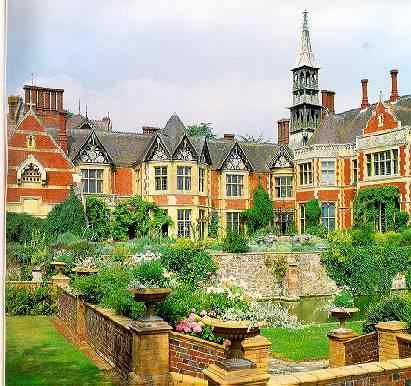
MADRESFIELD The Real Brideshead


Why Waugh went Mad
Lewis Jones

Published 26 June 2008 (New Statesman)


Madresfield: the Real Brideshead Jane Mulvagh Doubleday, 400pp, £20

Madresfield Court is an ancient and beautiful house in the blue remembered Malvern Hills. Evelyn Waugh first stayed there in 1931, broke and homeless after his divorce, and fell in love with the house and family - the Lygons. Waugh knew them through Hugh Lygon, for whom he had had a tendresse at Oxford, and who was charming, gay, drunk and doomed. Hugh had two brothers and four sisters, and the parents were absent (father in Venice, mother staying with her brother), so "Mad" became the refuge of such riff-raff as Robert Byron, Cecil Beaton, Randolph Churchill and Nancy Mitford - Liberty Hall, with liveried butlers, footmen and grooms.

Imaginatively at least, Madresfield was the consummation of Waugh's epic love affair with the upper classes. He wrote much of Black Mischief and Remote People there. His letters to "Darling Blondy & Poll" (Lady Mary and Lady Dorothy Lygon, aka Maimie and Coote) are among his funniest and most obscene. And the house looms in his subsequent novels. In A Handful of Dust, Hetton Abbey is exactly modelled on Madresfield, and in Brideshead Revisited house and family achieve operatic apotheosis.

"I am not I," declared Waugh on the title page of Brideshead, "thou art not he or she: they are not they." In a letter to Dorothy, he explained that he was writing a novel "all about a family whose father lives abroad, as it might be Boom [his friends' father, the 7th Earl Beauchamp] - but it's not Boom . . . and a younger son: people will say he's like Hughie, but you'll see he's not really Hughie - and there's a house as it might be Mad, but it isn't really Mad".

Right, yeah, not really, no, whatever. Roughly translated, Charles is Evelyn; Sebastian is Hugh; Marchmain is Beauchamp; Bridey is Elmley; Julia is Dorothy; and Cordelia is Mary. Madresfield, as the title of Jane Mulvagh's new book reminds us, is the Real Brideshead. And the Real Brideshead, furthermore, is most decidedly not Castle Howard, as seen in the TV adaptation.

The only drawbacks to this story as a subject are that it has already been told, and it isn't enough to fill a book. Mulvagh does her best to spin it out, topping and tailing her narrative with the Brideshead element and reserving Lord Beauchamp's exile for her finale. That leaves 320 or so pages to fill, which she does with an affectionate and lavishly illustrated history of the house and family. With courtyard, chapel, hall and scores of bedrooms, Madresfield is on the scale of an Oxford college, and the brickwork of its Victorian additions recalls the "holy zebra" style of Keble College, of which the 6th Earl Beauchamp, an ardent Tractarian, was a founder. In a thousand years, it has never been bought or sold. Its 12th-century outer doors, approached over a moat, have no handles, as it has never been left unattended.

The most interesting parts of the history involve artists. When, for example, a distant kinsman died intestate in 1798, the Lygons inherited a huge fortune - though the inheritance was disputed for an amazing 170 years, giving Dickens his model for the case of Jarndyce v Jarndyce in Bleak House. Edward Elgar's father used to tune the pianos at Madresfield, and the composer became a great friend of Lady Mary Lygon, whom he evoked in the "Romanza", the 13th of his Enigma Variations.

The 7th Earl - "Boom" - served in Asquith's cabinet, and thought it middle-class not to decant champagne into jugs. He was also homo sexual. Unluckily for him, his wife's brother was the 2nd Duke of Westminster, who hated him. Perhaps because his name was so gay, Bend'Or Westminster was a virulent homophobe, and when he learned Boom's secret he told George V that he would expose the earl. The king sent emissaries to Madresfield, where they persuaded Beauchamp to resign his official posts (all except for Lord Warden of the Cinque Ports) and to leave England by midnight.

He spent five years in exile in Paris, Venice, San Francisco and Sydney - gay-tolerant cities even then - until his daughter Sibell prevailed on Lord Beaverbrook, whose mistress she was, to persuade the home secretary to annul the warrant for his arrest. He returned to Madresfield, dying on a trip to New York two years later. Like the Flytes, the Lygon children drank too much and formed unsuitable relationships. "We ought not to go out with jockeys," Sibell noted in 1934.

Mulvagh is not altogether reliable in matters of style and fact. "Violent riots" is a tautology, for example, and Evelyn Waugh was not sent down from Oxford. And he would have hated the title: the Real Brideshead is to be found in his novel and it's all in the "as it might be".