


NEW & LINGWOOD
THE PAST
In 1865 Miss Elisabeth New and Mr Samuel Lingwood
founded the business which still bears their names, New & Lingwood. They
subsequently married and laid the foundation on which the business still prides
itself, unsurpassed quality of merchandise and truly personal service.
In 1922 New & Lingwood opened a shop in Jermyn
Street and although these premises were destroyed in the blitz during the
Second World War, we re-established our presence in the street shortly after
the war, this time at number 53, on the corner of the Piccadilly Arcade. It is
fair to say that today New & Lingwood is unique in London in being the most
traditional of the small number of gentleman's outfitters supplying bespoke and
ready-made shirts, hosiery and shoes of the highest quality.
The company was formed in Eton to serve the scholars
of Eton College, the most famous of English Public Schools, and soon gained
official status as outfitters to the College, a great honour for the firm. For
over 147 years New & Lingwood has served many thousands of Etonians, in
many instances five or more generations of the same family, on the same site it
has occupied since its foundation. This is a consequence of the high standards
of quality and service that New & Lingwood have maintained.
In 1972 the old and famous shoe and boot-making firm
Poulsen Skone joined the Company extending the classic range of shoes.

NEW & LINGWOOD
https://www.helenmasondesign.com/new-lingwood
HELEN MASON DESIGN
Based on previous experience of working with Helen, we
chose her to bring together our vision for what is a unique flagship store in
St James’s. Her strong work ethic and meticulous aesthetic meant that once
she’d been given the complex brief, she delivered something that both our own
staff, our builders and our PR agency were able to use extremely effectively.
Not only did she unify the many elements of the project, she also worked long
hours and late nights to ensure it was delivered on time and to budget. I
wouldn’t hesitate to work with her again.
— Simon Malony, Product and Marketing Director | New
& Lingwood
THE PROJECT
After producing events for New & Lingwood, we were
delighted to be asked to work on the design of the refurbishment for their two
flagship stores in Jermyn Street.
New & Lingwood is a brand with 153 years of rich,
traditional English heritage, a storied outfitter for Eton and bespoke men’s
wear maker that heralds back to 1865.
In 1922, New & Lingwood expanded from Eton into
London and today have an international reputation as a quintessentially English
gentleman's outfitters, with eccentric flair.
Their two London stores are located on the corner of
the Piccadilly Arcade, facing Jermyn Street, and they’ve held residence there
since 1946.
New & Lingwood have established themselves as a
forward looking luxury design brand, and sought to refresh their Jermyn Street
stores to reflect this development.
THE BRIEF
To create an open, bright and vibrant design which
reflected the brand’s character and wit. Introduce more retail theatre to the
space whilst retaining the unique heritage and maintaining continuity for loyal
customers.
THE METHOD
We provided a design overview for the refurbishment -
from conceptual drawings to the final finishing touches – with a hands on
approach throughout the project.
Working closely with Mark Clark Associates, we
filtered the ideas of the fantastic creative team at N & L, then presented
conceptual designs, colour rendered perspectives and mood-boards, which enabled
the client to visualise and approve the proposed changes.
The refit was extensive, requiring a total
refurbishment, so each store was closed in tandem whilst the work took place.
Working successfully within a strict timeframe the
transformation was completed on schedule.
The smaller store was transformed into an opulent silk
and gown space, with fittings and furnishings deliberately chosen to tell a
story and to coordinate with the larger store.
With the installation of a layered lighting scheme,
rich silk drapes, a bold tartan carpet and multitude of meticulous finishing
details the stores were transformed.
We employed British companies to reflect the brand’s
ethos and create classic style and quality craftsmanship throughout the stores.
Cabinet makers, Silk weavers, Paint manufacturers, Carpet makers and Velvet
suppliers were all sourced in the UK.
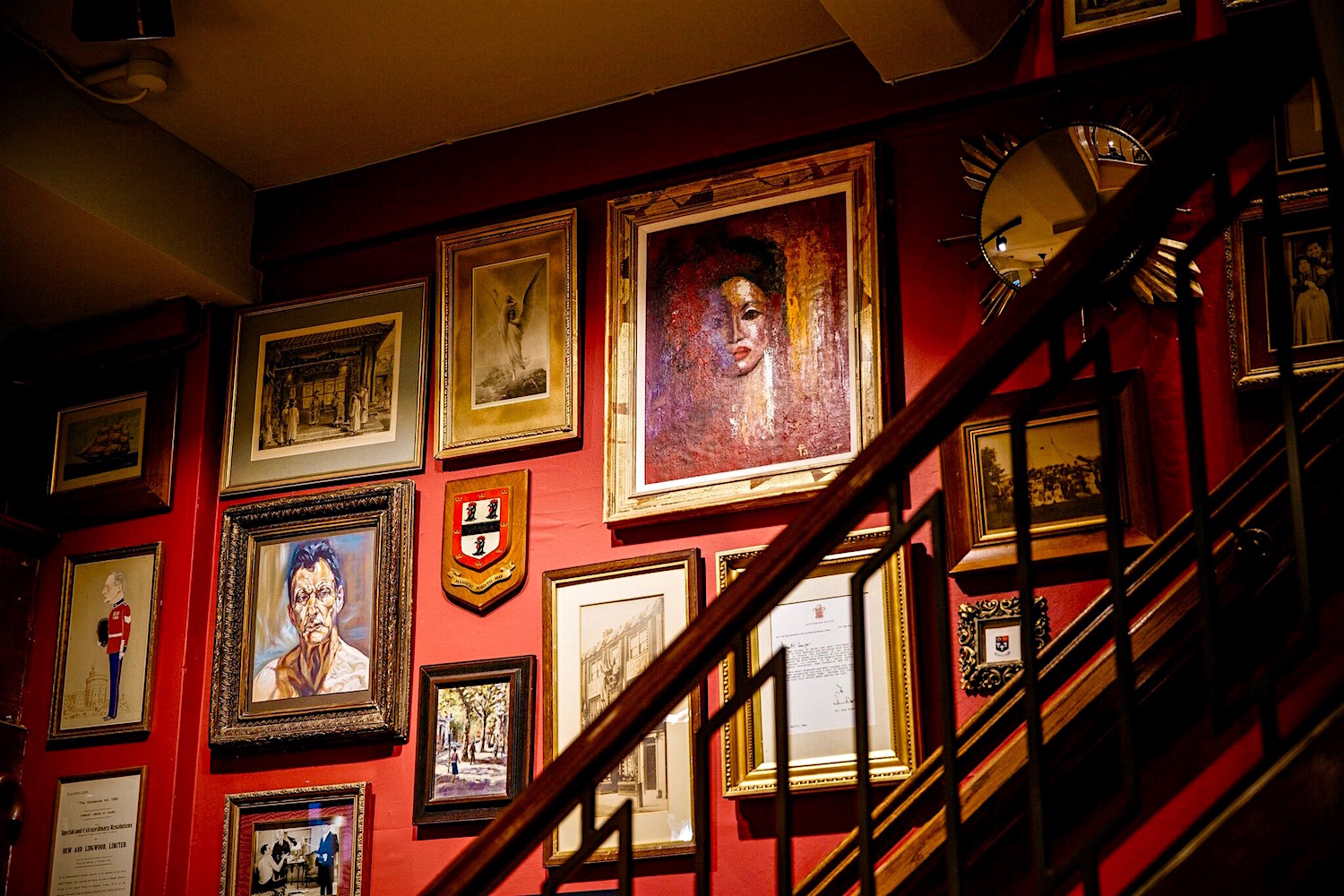
The tone was set using Mylands beautiful paints.
Museum Teal was used throughout both stores, a beautiful tranquil colour and a
perfect backdrop to showcase the product. In contrast the Theatreland Red
feature walls offset the picture walls to perfection.
N & L are famous for their Jacquard silk dressing
gowns. In tribute a bespoke silk fabric was created especially for the project
and incorporated in the changing room drapes and numerous stairwell and cabinet
panels.
THE RESULT
The stores now have an ambient welcoming appeal, with
natural light streaming in through new entranceways,
Scrumptious design detail throughout and a stunning new lighting design all bringing fresh life and energy to the brand




Our Eton Connection
.jpg)


Our Eton Connection
Not just a uniform, a mark of honour and pride
https://www.newandlingwood.com/eton-connection
ETON STORE
118 High
Street, Eton,
Windsor,
Berkshire,
SL4 6AN
Since our
founding in 1865 New & Lingwood has proudly outfitted the students of Eton
College. From uniform essentials, our extensive offer of house and society
colours through to refined tailoring, shirts, shoes and silk accessories, our
Eton store has something for gentlemen of all ages.
We apply
personalised name tags to all newly purchased uniform and any alterations are
made at no extra cost. Plus, we will provide free dry cleaning for the first
term of the new school year.
Additionally,
each new boy who purchases his full school uniform from New & Lingwood will
be invited to sign our uniform register which will entitle him to two free
formal shirts upon his departure, post A Levels.


THE GLOBAL
PROFILE
A Portrait Artist Fit for a King (but Not a
President)
Jonathan Yeo, about to unveil a major new painting of
King Charles III, also counts Hollywood royalty (Nicole Kidman) and prime
ministers (Tony Blair) as past subjects. But George W. Bush eluded him.

Mark
Landler
By Mark
Landler
Reporting
from London
Published
May 2, 2024
Updated May
15, 2024
Few famous
Britons, it seems, can resist the chance to be painted by Jonathan Yeo. David
Attenborough, the 97-year-old broadcasting legend, is among those who have
recently climbed the spiral stairs to his snug studio, hidden at the end of a
lane in West London, to pose for Mr. Yeo, one of Britain’s most recognized
portrait artists.
Yet when it
came to painting his latest portrait, of King Charles III, the artist had to go
to the subject.
Mr. Yeo
rented a truck to transport his 7.5-by-5.5-foot canvas to the king’s London
residence, Clarence House. There, he erected a platform so he could apply the
final brushstrokes to the strikingly contemporary portrait, which depicts a
uniformed Charles against an ethereal background.
The
painting, which will be unveiled at Buckingham Palace in mid-May, is the first
large-scale rendering of Charles since he became king. It will likely reconfirm
Mr. Yeo’s status as the go-to portraitist of his generation for Britain’s great
and good, as well as for actors, writers, businesspeople and celebrities from
around the world. His privately commissioned works can fetch around $500,000
each.


Painting
the king’s portrait also marks a return to normalcy for Mr. Yeo, 53, who
suffered a near-fatal heart attack last year that he attributes to the
lingering effects of cancer in his early 20s. The parallel with his subject is
not lost on him: Charles, 75, announced in February that he had been diagnosed
with cancer, just 18 months into his reign.
Mr. Yeo
said he did not learn of the king’s illness until after he had completed the
painting. If anything, his depiction is of a vigorous, commanding monarch. But
it gave Mr. Yeo deeper empathy for a man he got to know over four sittings,
beginning in June 2021, when Charles was still the Prince of Wales and
continuing after the death of his mother, Queen Elizabeth II, and his
coronation last May.
“You see
physical changes in people, depending on how things are going,” Mr. Yeo said in
his studio, where he had decorously turned the as-yet-unveiled painting away
from the gaze of curious visitors. “Age and experience were suiting him,” he
said. “His demeanor definitely changed after he became king.”
The
portrait was commissioned by the Worshipful Company of Drapers, a medieval
guild of wool and cloth merchants that is now a philanthropy. It will hang in
Drapers’ Hall, the company’s baronial quarters in London’s financial district,
which has a gallery of monarchs from King George III to Queen Victoria. Mr.
Yeo’s Charles will add a contemporary jolt to that classical lineup.
“What Jonny
has succeeded in doing is combining the elusive quality of majesty with an
edginess,” said Philip Mould, a friend and art historian who has seen the
painting and called it “something of a unicorn.”
Fighting
Child Marriage in Malawi: At age 13, Memory Banda’s 11-year-old sister was
forced to wed a man in his 30s who had impregnated her. It was a moment of
awakening for the self-described “fierce child rights activist.”
A Portrait
Artist Fit for a King: Jonathan Yeo, about to unveil a major new painting of
King Charles III, also counts Hollywood royalty (Nicole Kidman) and prime
ministers (Tony Blair) as past subjects. But George W. Bush eluded him.
Inspiration
in Germany’s History: Jenny Erpenbeck became a writer when her childhood and
her country, the German Democratic Republic, disappeared, swallowed by the
materialist West.
Mr. Yeo is
no stranger to depicting royals. He painted Charles’ wife, Queen Camilla, who
he said was a delight, and his father, Prince Philip, who was less so. “He was
a bit of a caged tiger,” Mr. Yeo recalled. “I can’t imagine he was easy as a
father, but he was entertaining as a subject.”
Still, a
sitting monarch was a first for Mr. Yeo, whose subjects have included prime
ministers (Tony Blair and David Cameron), actors (Dennis Hopper and Nicole
Kidman), artists (Damien Hirst), moguls (Rupert Murdoch) and activists (Malala
Yousafzai).
Mr. Yeo
said there was an element of “futurology” to his work. Some of his subjects
have gone on to greater renown after he painted them; others have faded. A few,
like Kevin Spacey, who was tried and acquitted on charges of sexual misconduct,
have fallen into disrepute. The National Portrait Gallery in Washington
returned Mr. Yeo’s Spacey portrait, made when the actor played a ruthless
politician in the series “House of Cards.”
Gazing back
over his A-list subjects, Mr. Yeo has developed a few rules of thumb about his
art. Older faces are easier to capture than younger ones because they are more
lived in. The best portraits capture visual characteristics that remain
relevant even as the person ages. And the only bad subjects are boring ones.
“He didn’t
want me to pose, he just wanted me to talk,” said Giancarlo Esposito, the
American actor known for playing elegant villains in the crime classic
“Breaking Bad” and the recent Guy Ritchie TV series, “The Gentlemen.” As an
actor, Mr. Esposito said, he was skilled at projecting a persona, “but there
was no way to fool him.”
“It was an
opportunity to be Giancarlo, unmasked,” said Mr. Esposito, who said he last
posed for a portrait as a child at a county fair.
A
loose-limbed figure with a quick smile and stylish eyeglasses pushed far back
on his forehead, Mr. Yeo learned his appreciation for the charms and foibles of
public figures by being the son of one. His father, Tim Yeo, was a Conservative
member of Parliament and minister under Prime Minister John Major, whose career
was undone by professional and personal scandals.
At first,
the elder Mr. Yeo had little patience for his son’s artistic dreams. “My dad
definitely assumed I’d need to get a proper job,” he said, giving him no money
when he took a year off after high school to try to make it as a painter. Mr.
Yeo’s early efforts showed his lack of formal training, and “obviously, I
didn’t sell any pictures.”
Then, in
1993, at the end of his second year at university in Kent, he was struck by
Hodgkin’s disease. Mr. Yeo burrowed deeper into painting as a way of coping
with the disease. He got a break when a friend of his father — Trevor
Huddleston, an Anglican archbishop and anti-apartheid activist — commissioned
him for a portrait.
“He asked
me mostly out of pity,” Mr. Yeo recalled. “But it turned out spectacularly,
better than anyone expected.”
The
commissions began to flow, and Mr. Yeo became sought-after for his revealing
portraits of famous faces. In 2013, the National Portrait Gallery in London
mounted a midcareer exhibition of his work.
“He brought
the portrait back,” said Nick Jones, the founder of Soho House, a chain of
private members’ clubs, which worked with Mr. Yeo to hang paintings by him and
other artists on its walls. “Portraits were always such severe things,” Mr.
Jones said. “He was able to add layers and bring out the personality of the
people.”
It helps
that Mr. Yeo is well-connected, prolific and entrepreneurial. He is cleareyed
about the commercial side of his art. “No matter how you dress it up,” he said,
“to some extent, you’re in the luxury goods business.”
Successful
but creatively restless, Mr. Yeo began experimenting. When aides to President
George W. Bush contacted him to do a portrait and later dropped the project, he
decided to do it anyway, but as a collage of images cut out of pornographic
magazines.
The Bush
portrait went viral on the web, and Mr. Yeo created collages of other public
figures, including Hugh Hefner and Silvio Berlusconi. It was provocative but
time-consuming work — he bought stacks of skin magazines to assemble enough raw
material — and his supply dried up when, he said, “the iPad killed the
porn-magazine industry.”
Mr. Yeo
also became drawn to the uses of technology in art. He worked on design
projects at Apple. He painted the celebrity chef, Jamie Oliver, via FaceTime
during the pandemic. And he created an app that offers a virtual-reality tour
of his studio, a well-appointed space in an old workshop that once turned out
organs.
But on a
Sunday night in March 2023, Mr. Yeo’s busy life came to a terrifying halt. He
went into cardiac arrest — his heart stopping for more than two minutes. Mr.
Yeo said he believes the crisis was linked to his cancer treatment decades
earlier. While he did not see a bright light at the end of a tunnel, as others
with near-death experiences have described, he recalled a palpable sensation of
floating outside his body.
Mr. Yeo,
who is married and has two daughters, clung to life. After recuperating, he
found that his vocation as a painter — temporarily diverted by his detours into
technology and other pursuits — had been rekindled. Soon, he was immersed in
the portraits of Charles, Mr. Esposito and Mr. Attenborough.
“It
definitely makes you feel, ‘Let’s not mess around anymore,’” Mr. Yeo said.
“It’s like dodging a bullet.”
Mark
Landler is the London bureau chief of The Times, covering the United Kingdom,
as well as American foreign policy in Europe, Asia and the Middle East. He has
been a journalist for more than three decades. More about
Mark Landler


Account
These Butlers Are Neither Carson Nor Hudson
The rise of “executive butlers” — a breed whose job
combines silver polishing with being a concierge and a maitre d’ — reflects the
changing nature of the very rich.

By Plum
Sykes
Plum Sykes
reported this story from her home in Britain’s Cotswolds region. She has
written about society for magazines and in several novels.
May 14,
2024
https://www.nytimes.com/2024/05/14/style/executive-butlers-country-houses.html
In
Britain’s bucolic Cotswolds region, the arrival of summer is typically marked
by a migration. Specifically, the return of a rarefied group to grand country
houses in counties like Oxfordshire or Gloucestershire, where preparations
begin for a season of hosting guests at picnics, luncheons and events like the
Chelsea Flower Show, the Royal Ascot horse races and “the tennis” — shorthand
for a center court box at Wimbledon.
Owners of
those country estates — let’s call them the one percent of the one percent — of
course do not handle such preparations themselves. These are relegated to
butlers, whose job, like for others associated with the lifestyles of the
ultrawealthy, has evolved.
As personal
assistants have been rebranded as executive assistants and child care providers
as executive nannies, buttling has become a career that involves not only
polishing silver and folding napkins but also lifestyle management.
The modern
butler — also known as, wait for it, an executive butler — is still in most
cases a man. But he is no longer a grandfatherly type in morning trousers that
stays in the background, if not out of sight. More likely, he is fresh-faced,
wears a lounge suit with a Charvet tie and is by his employers’ side whether
they are at home or not.
“They’re
like a private maitre d’ now,” said Nicky Haslam, 84, the English interior
designer and social fixture. “In the old days the butler was in the house all
the time. Now, if the family is on their yacht, the butler goes with them.”
This was
not the case as recently as the 1990s, when butlers for the most part reflected
the archetype popularized by characters like Hudson, from the TV show
“Upstairs, Downstairs”; Carson, from “Downton Abbey”; or Stevens, from Kazuo
Ishiguro’s novel “The Remains of the Day.”
Among that
ilk was Michael Kenneally, a mischievous Irish butler employed for decades by
my cousin, Sir Tatton Sykes, at his country estate, Sledmere, in the county of
Yorkshire.
His antics
were legendary. If children were visiting, he would sometimes accessorize his
formal uniform with a curly-haired wig or glasses with plastic eyeballs on
springs. His pièce de résistance was riding through the dining room after
dinner on a bicycle with a port tray balanced on the handlebars, a trick that
was noted in his obituary in The Telegraph. When he died at 65 in 1999, his
funeral drew a crowd of about 300 people, and he was buried alongside members
of the family that had employed him for 40 years. On the headstone marking his
grave, the epitaph simply read “The Butler.”
The
profession’s evolution in recent decades is a signifier of a societal shift in
Britain: What rich people want has changed because who rich people are has
changed.
That
group’s makeup has shifted from being primarily aristocratic families, the type
long associated with traditional butlers, to include a new breed of self-made,
high-net-worth individuals who have built fortunes in industries like
technology and media and who see butlers less as part of the furniture and more
as a flashy accessory.
Graeme
Currie, 53, exemplifies the modern butler, a role that he said requires
“sparkle, darling, sparkle.” He has been employed by some of Britain’s
highest-profile families and was the head butler for 10 years at Weston Park,
an estate in the county of Staffordshire that is the ancestral home of the Earl
of Bradford and can now be booked for private events.
This summer
Mr. Currie — who has tawny hair and, often, a light tan — is planning to travel
to various destinations in Europe to buttle at vacation houses. In his spare
time, he breeds toy poodles, some of which have competed at dog shows like
Crufts.
Mr. Currie
is the sort of person who can whip up an espresso martini blindfolded and
comprehend the precise level of froth someone might prefer for a coconut-milk
cappuccino. He developed such skills in part from a career in hospitality that
has included jobs on the Queen Elizabeth 2 ocean liner and at ritzy London
hotels like the Dorchester and Claridge’s and restaurants like the Ivy.
“The
difference between me and an old-fashioned butler is that I’ve had the
experience of people paying for dinner and of always being critiqued,” Mr.
Currie said.
Seasoned
butlers like him can make around 100,000 British pounds a year, or about
$125,000. The job’s starting salary is closer to 40,000 pounds, or $50,000.
For butlers
with full-time positions, various costs — food, lodging, even fancy uniforms —
are subsidized by employers. And those who work in Europe are typically
afforded the same mandatory benefits granted to other workers, like a minimum
of 20 vacation days. Many develop schedules with their employers that include
regular time off on the weekend or midweek to account for other days when they
are expected to work long hours.
Mr. Currie
was drawn to the profession for a reason that many butlers are: He is
passionate about taking care of people.
“One thing
I always say is that I’m very good at remembering who people are and what they
want,” he said. “You’ve got to have a whole repertoire in your brain because
people ask for things they have never asked for before.”
That
repertoire can vary wildly depending on a butler’s location, said Niels
Deijkers, the managing director of the International Butler Academy in
Simpelveld, the Netherlands.
Mr.
Deijkers recalled a story he had heard from an executive butler who was with a
family on a yacht. “The client pointed toward the coastline and said, ‘Tonight
I’d like to have dinner on top of that mountain — please arrange it,’” he said,
explaining that the butler contacted a restaurant in the area, which “set up a
table for six and flew in everything with a helicopter.” (Mr. Deijkers
estimated that the dinner cost “around $300,000.”)
Andrew
Gruselle, 53, has encountered similar demands in his time working on Lamu
Island, off the coast of Kenya, where he has managed grand beachfront
properties with staffs that have included cooks, housekeepers and pool
attendants.
In his
typical uniform of loose cotton shirt and seersucker Bermuda shorts, Mr.
Gruselle has performed a range of duties: serving trays of fresh mango or
papaya for breakfast; arranging water-skiing excursions; recommending fabric
shops; securing reservations at the Peponi Hotel, a Lamu hot spot; and
wrangling six donkeys to stage a makeshift Nativity scene at Christmas.
“When
someone comes out here,” he said, “you have to be very careful that they are
looked after properly, and that it’s a seamless experience for them.”
Carole
Bamford, 78, expects nothing less of the head butler at Daylesford House, her
country estate in Gloucestershire, one of several homes she resides at with her
husband, Anthony Bamford, the billionaire owner of the British construction
company JCB.
Events held
at Daylesford House by the couple, known formally as Lord and Lady Bamford, are
among the most coveted invitations in the Cotswolds. This spring Lady Bamford,
who is the founder of Daylesford Organic, a popular British lifestyle brand,
hosted various lunches with themes inspired by plants grown on the estate like
snowdrops and tulips.
Leading the
preparations for those lunches was, yes, Daylesford House’s head butler, whose
résumé reflects those of traditional butlers, in that he has been with the
Bamfords for more than 20 years.
“He was
with the queen for about eight years before me,” Lady Bamford said.
But his job
also involves many duties expected of modern butlers, too.
Lady
Bamford recalled a recent lunch where the menu included lamb, purple sprouting
broccoli, a cheese board, panna cotta and rhubarb bellinis.
“Who makes
the bellinis?’” I asked.
“Well, the
butler,” she said.
Susan
Beachy contributed research.
Plum Sykes
is the author of “Bergdorf Blondes,” “The Debutante Divorcée,” “Party Girls Die
in Pearls” and the just released “Wives Like Us.”


.jpeg)
https://lairdlondon.co.uk/pages/about-us
At Laird,
we hand make hats and caps of distinction for both men and women, and are
passionate about sourcing the best British cloths, and supporting British
textile manufacturing. A Laird hat evokes a rich English and Scottish heritage,
with a modern nuance. The great fabric finishes and rich colour palettes make
our headwear stand out, as well as the wonderful craftsmanship. Our look is
slick, with strong lines, deep colours and bold statements.
Our aim is
always to give our clients a wonderful, stylish product, but also great service
in our shops or online: friendly, personal, prompt and informative. Laird
Hatters is here to make you look and feel great!
PR showroom
appointments - please contact (task pr)
Magazine
Press loans please email - info@lairdhatters.com


.webp)


