German authorities have arrested a 33-year-old German citizen on suspicion
of arson after a massive fire completely engulfed the historic
Kehlsteinhaus, widely known as Adolf Hitler’s "Eagle’s Nest" mountain
retreat in the Bavarian Alps.
-
Suspect arrested over fire at Hitler’s ‘Eagle’s Nest’ retreat in Bavaria
German authorities have arrested a *33-year-old German citizen on suspicion
o...
Thursday, 21 September 2023
Wednesday, 20 September 2023
Tuesday, 19 September 2023
Monday, 18 September 2023
Why Liz Truss gets an honours list, despite only being PM for 49 days
Labour
frontbencher Jonathan Ashworth wrote to the Prime Minister calling on him to
block Ms Truss’s yet-to-be published resignation honours list.


( … ) Ahead
of the speech, Labour frontbencher Jonathan Ashworth wrote to the Prime
Minister calling on him to block Ms Truss’s yet-to-be published resignation
honours list.
In the
letter to Mr Sunak, he said: “Families and business across Britain are still
paying (the) price for the Conservative Party crashing the economy and leaving
working people worse, with higher taxes, higher mortgages and higher food and
energy bills.
“Despite
this, it has been widely reported that Liz Truss has submitted up to 14 people
to receive resignation honours.
“This means
that those who crashed the economy, who left millions to pay more for their
mortgage and who undermined our economic institutions could receive an award.
“I urge you
to block these honours.”
Liberal
Democrat deputy leader Daisy Cooper mocked Ms Truss.
She said:
“Liz Truss giving a speech on economic growth is like an arsonist giving a talk
on fire safety.”
Boris, the Lord & the Russian Spy | Dispatches | Channel 4 Documentaries


This article is
more than 2 months old
Queen was asked to block Evgeny Lebedev’s
peerage, claims documentary
Exclusive: Channel 4 film says officials contacted the
palace in 2020 owing to concerns about Lord Lebedev’s father’s links to Putin
regime
Pippa
Crerar and Luke Harding
Sun 25 Jun
2023 13.59 EDT
Government
officials asked whether the late Queen would block Evgeny Lebedev’s peerage
because of concerns that he could be a national security risk due to his
father’s links to the Putin regime, a documentary has claimed.
The aides
contacted Buckingham Palace in July 2020 to request that the monarch intervene,
which she was constitutionally entitled to do, after Boris Johnson decided to
press ahead with the controversial peerage despite warnings from the
intelligence agencies, according to the film-makers.
The Palace
is understood to have refused, fearing that the irregular request would drag
the Queen into controversial political matters, and his elevation to the House
of Lords as Baron Lebedev of Hampton and Siberia went ahead that December.
The
Guardian first reported in October 2020 that the UK security services had
briefed the House of Lords Appointments Commission (Holac), which scrutinises
the nomination of new peers, that Lebedev was viewed as a potential national
security risk because of his father, Alexander Lebedev, a billionaire oligarch.
Yet
although they did not say that Evgeny himself was a risk, they did raise his
father’s ongoing relationship with the Kremlin, according to the Channel 4
documentary Boris, the Lords & the Russian Spy: Dispatches.
Two
intelligence officers were invited into Downing Street to brief Johnson in
person about their security concerns in spring 2020, according to the
documentary. Officials then took the unusual move of contacting the palace, it
claimed.
Lord Clark,
a Labour peer and member of Holac who vetted Lebedev’s nomination, said Johnson
was “quite determined” to “get his own way”, that he “threatened” the usual
conventions and “tried to overrule – and did overrule” security advisers and
Holac.
Speaking
publicly for the first time about the nomination, he said that it would have
been unprecedented for No 10 to ask for the Queen to intervene. “I’ve never
heard of officials seeking a meeting with Her Majesty to discuss these issues,”
he said.
“We’ve got
to remember these people [officials], they are aware of things which you and I,
aren’t aware of. Therefore they have knowledge. They were really concerned
about this. They thought it was a major, major mistake.”
Johnson has
run into further trouble over Lords appointments since being forced out from
Downing Street last year, with just seven of the names out of an original 16 on
his controversial resignation honours list being awarded peerages.
Clark said
of Lebedev’s peerage: “Every other prime minister by and large followed the
conventions. Boris Johnson was quite determined that he was going to get his
own way.
“And that
threatened the whole notion of conventions which make British government work.
And it was a real threat. He disregarded the constitution, and that is a very
dangerous position.”
He added:
“He tried to overrule – and did overrule – the security advisers and the House
of Lords Appointments Commission. The whole point of [Holac] was actually to
try and give the civil population a real say in the safety, their safety, of
the country.”
A
spokesperson for Johnson told the Guardian: “Boris Johnson is fully supportive
of Lord Lebedev’s appointment. As the government has previously confirmed,
Holac and security advice was not overruled. The proper process was followed.
As this programme makes clear, there were no concerns about Lord Lebedev.
“Lord
Lebedev is a British citizen. He has invested in British journalism and has
extensively criticised the Russian regime. It is not right to judge people on
the basis of their country of birth or the sound of their surname. This is a
tiresome and xenophobic campaign.”
However,
Lord Bew, the chair of Holac, confirmed last year that MI5 raised security
concerns when Lebedev, who owns the Evening Standard and holds a minority stake
in the Independent newspapers but derives his wealth from his father, was
proposed for a peerage in March 2020.
A further
update that June then concluded, according to the Sunday Times, that any
security risk associated with the newspaper owner would be low, because peers
do not routinely see classified government documents.
A letter
from Lord Bew to Johnson the following month, which has been seen by
film-makers, noted: “The security services have highlighted significant
potential risks in respect of the nominee’s familial links, and the potential
vulnerability of any information obtained by the nominee from his association
with UK officials or government.”
Dominic
Cummings, the former No 10 aide, said in March 2022 that he was in the room
when Johnson was told of “serious reservations” that “parts of the deep state”
had about his plan to award Lebedev a peerage, and that Johnson had reacted
furiously.
In a
controversial break with precedent, Johnson decided to press ahead with
Lebedev’s proposed peerage regardless. He argued that, as there was no evidence
linking Lord Lebedev himself to the Putin regime or Russian intelligence, it
could go ahead.
A
spokesperson for Lord Lebedev told the documentary makers: “He is familiar with
the security advice and understands no such attempt was made by the security
services to persuade the PM to withdraw the nomination.”
Lebedev has
previously said he is “not a security risk to this country, which I love”, and
recently issued a statement through one of the newspapers he owns, the Evening
Standard, in which he dismissed the “farcical” speculation as Russophobia.
Alexander
Lebedev, a KGB spy in London between 1988 and 1992, was sanctioned by Canada in
May 2022, together with 13 other Russian oligarchs, for allegedly facilitating
Vladimir Putin’s “senseless” full-scale attack of Ukraine.
The
documentary claims that Canada’s decision to sanction Lebedev was in part based
on intelligence which, its makers understand, came from MI6, although the
British government had not itself imposed sanctions on the former KGB officer.
Dennis
Molinaro, a Canadian former national security analyst, told the film-makers
that he thought it likely Lebedev “has some type of connection to the Kremlin
and to Putin and is worthy of being sanctioned in Canada … It would be unusual
for the Canadian government to make a decision about sanctioning someone in the
UK without having some information on that individual from the UK.
“It’s
unclear why at the political level [in the UK], nothing’s been done in terms of
sanctioning him. My concern would be based on Alexander’s history in the UK,
that he has been engaged in a level of influence operations in the UK.
“If you
have politicians that can be compromised by foreign states, it can lead to
sharing of secrets. It could lead to steering of policy in their interests. It
could lead to a fracturing of an alliance that the west has depended on to
maintain the current international order and system. If that goes, we don’t
have much left.”
Alexander
Lebedev has been approached for comment. Buckingham Palace declined to comment.
This article was amended on 27 June 2023 to
clarify the extent of Evgeny Lebedev’s role in two newspapers; he owns the
Evening Standard and holds a minority stake in the Independent.
Saturday, 16 September 2023
258 years of the British Museum / What a Scandal at the British Museum Reveals
OPINION
GUEST ESSAY
What a Scandal at the British Museum Reveals
Sept. 16,
2023
https://www.nytimes.com/2023/09/16/opinion/museum-artifacts-looting.html


Credit...Rozalina
Burkova
By Jason
Felch
Mr. Felch
is a co-author of “Chasing Aphrodite: The Hunt for Looted Antiquities at the
World’s Richest Museum.”
Sign up for
the Opinion Today newsletter Get expert
analysis of the news and a guide to the big ideas shaping the world every
weekday morning. Get it sent to your inbox.
The news
that roughly 2,000 objects, dating from antiquity to the 19th century, have
disappeared over a decade from the vast storerooms of the British Museum — a
fact the museum acknowledged a few weeks ago — should be enough to endanger the
job security of any museum’s director. Add in the news that the thief is
suspected to have been a curator of Greek antiquities at the museum, and that
the precious objects were being peddled in the digital marketplace, and you can
understand why the museum’s director recently resigned.
These
revelations have shaken the staid museum world and raised important questions
about security, record keeping and funding priorities. But the root problem
goes deeper, to the origins of our national museums. And the fix will take more
than new security protocols.
The British
Museum must use this scandal as an opportunity to update the dusty notion of
the so-called universal museum — rethinking how these institutions can exist in
a 21st-century world where the sharing and blending of cultures has never been
more crucial. Rather than resisting calls to repatriate contested objects in
their collections, museums should be transparent about their holdings and how
they were acquired. They should embark on a campaign of generous, long-term
loans that allows objects to circulate freely across borders. And they should
embrace digital tools to open their storage facilities to public scrutiny.
This is an
opportunity to radically reimagine the mission and purpose of the universal
museum — places like the Metropolitan Museum, the Louvre, the Prado and the
British Museum — and what they owe to the world.
The dream
of a “universal” or “encyclopedic” museum was born centuries ago as a product
of the Enlightenment. During the 1700s, in a burst of noblesse oblige, many art
collections were moved from private drawing rooms into public spaces, where
they theoretically could be appreciated by all. The grand institutions that
were built over the next century to house them were established on the notion
that access to the world’s art and artifacts would foster an enlightened,
democratic culture — and, implicitly or explicitly, on the idea that only
institutions in the West could properly preserve, protect and study the world’s
great wonders.
The
Enlightenment led into the age of empire, and these new museums were quickly
filled with plunder. Thomas Bruce (a.k.a. Lord Elgin) whisked sculptures from
the Parthenon away to London. “The Winged Victory of Samothrace” landed in the
Louvre. The “Benin Bronzes” were dispersed around the globe, including to the
Met. Egypt’s Nefertiti bust was shipped off to Berlin.
At the
time, many considered this kind of acquisition to be benign, even necessary,
arguing that the museums would be suitable curators and custodians of the
objects. That view is still invoked as the rationale to keep vast collections
of antiquities in museum storerooms now. In 2002, more than a dozen leading
museums, including the Louvre and the Met, signed on to a “Declaration on the
Importance and Value of Universal Museums,” partly as a retort to Greece’s
nagging claims for a return of the Parthenon marbles in London and to the
growing criticism that these museums embodied a colonial view of culture that
needed correcting.
“Over time,
objects so acquired — whether by purchase, gift or partage — have become part
of the museums that have cared for them, and by extension part of the heritage
of the nations which house them,” the statement read. “To narrow the focus of
museums whose collections are diverse and multifaceted would therefore be a
disservice to all visitors.”
But the
theft of objects from the bowels of the British Museum put the lie to that
threadbare view: If these institutions fail at the fundamental task of
physically protecting the treasures they are supposedly preserving, how can
they justify keeping things they themselves have taken from other societies?
Indeed, the
British Museum thefts might have gone unnoticed if not for an antiquities
dealer who was browsing eBay and recognized an ancient Roman cameo as one from
the museum’s collection. The dealer notified the museum in 2021 that, after
tracking and buying many such objects, he had identified the anonymous seller
via a PayPal account. The evidence presented by the dealer was doubly
disturbing: Not only were the thefts an inside job, but they were allegedly
carried out by a curator (who is now facing a police investigation) whose duty
was to protect these objects.
As an
investigative reporter, I spent years uncovering how the J. Paul Getty Museum,
along with peer institutions in Boston, New York and elsewhere, had built
world-class collections of Classical antiquities in the 1980s and ’90s by doing
business with a thriving black market. After the Getty’s curator was criminally
charged by the Italian government (a case that was later dropped when a
three-judge panel ruled that the statute of limitations had expired), the
mounting evidence compelled several museums to return over 100 looted
antiquities to Italy, Greece, Turkey and beyond.
Several
antiquities dealers have likewise been heavily involved in the theft and sale
of antiquities from across Asia, selling them to collectors and museums,
including some in the United States. Some of the dealers have since faced
criminal charges, and federal agents at Homeland Security Investigations, the
Immigration and Customs Enforcement agency usually charged with investigating
antiquities trafficking, have worked with federal and state prosecutors to
seize and repatriate tens of thousands of looted objects.
European
museums are facing a similar reckoning about their colonial acquisitions. A
report commissioned by France’s president recommended the restitution of major
artifacts and any illegally obtained works to African countries on the basis of
bilateral agreements. Last year, Germany announced it would return more than
1,000 bronzes from the historical Kingdom of Benin.
As the very
first of the universal museums, the British Museum built its collection over
several hundred years of colonial boondoggles and the result is a treasure
house of epic proportions: The collection contains some eight million objects
(nobody knows for sure), of which only about 4.5 million have been fully
documented online. A mere 1 percent are on display. But the museum is largely
prohibited by law from disposing of its holdings, and it has often justified
its position by invoking its ability to safeguard the world’s treasures.
That
position no longer makes sense. The universal museum, a relic of the
Enlightenment, was never truly universal: Virtually all universal museums
reside in Western cities, far beyond the reach of many of the communities from
which their objects were taken. And there is nothing enlightened about hoarding
the world’s culture in storage, unseen by many and often, apparently, unsafe.
Jason Felch
is a former investigative reporter for The Los Angeles Times and a co-author of
“Chasing Aphrodite: The Hunt for Looted Antiquities at the World’s Richest
Museum.”
The Times
is committed to publishing a diversity of letters to the editor. We’d like to
hear what you think about this or any of our articles. Here are some tips. And
here’s our email: letters@nytimes.com.
Follow The
New York Times Opinion section on Facebook, Twitter (@NYTopinion) and
Instagram.
Thursday, 14 September 2023
Coco Chanel exhibition reveals fashion designer was part of French resistance
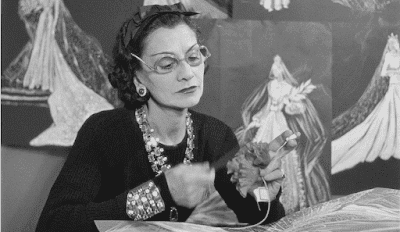
Coco Chanel exhibition reveals fashion designer
was part of French resistance
Previously unseen documents to go on display at
V&A alongside evidence of her collusion with Nazis
Jess
Cartner-Morley
@JessC_M
Sat 9 Sep
2023 06.00 BST
A major
retrospective of Coco Chanel has unearthed evidence that the fashion designer
was a documented member of the French resistance. The previously unseen
documents will go on display, along with contradictory evidence that she
operated as a Nazi agent.
The
documents relating to Chanel’s activities in wartime Paris strike a serious
note within what is likely to be the most glamorous exhibition of the year,
with more than 50 tweed suits – including a bubblegum pink set belonging to
Lauren Bacall – on view at Gabrielle Chanel: Fashion Manifesto, when it opens
at the V&A in London on 16 September.
“We
couldn’t do a show about Chanel and not address her wartime record,” said the
curator, Oriole Cullen, who has expanded a show first created at the Palais
Galliera in Paris in 2020 with a new curation that delves more deeply into
Chanel’s links with Britain as well as her wartime activities.
Previously
unseen documents highlight the name “Gabrielle AKA Coco Chanel” on a list of
400,000 people whose part in the resistance is backed up by official records.
“We have verification from the French government, including a document from
1957, which confirms her active participation in the resistance,” said Cullen.
The museum
will also display strong evidence that Chanel collaborated with the Germans in
occupied Paris, including transcripts of postwar interrogation of three Nazi
officials who all separately name her as a trusted source.
“The new
evidence doesn’t exonerate her. It only makes the picture more complicated. All
we can say is that she was involved with both sides,” said Cullen.
In contrast
to the museum’s recent Dior show, which told the story of a fashion house that
has outlived its founder by 66 years, the Chanel exhibition ends with her death
in 1971. The exhibition is personal, and therefore, by dint of Chanel’s
controversial life, political.
Cullen
points to a childhood spent in a French convent after the death of her mother
and disappearance of her father as having produced a character whose
inclination for self-protection made her instinctively rightwing. She said the
designer was “more than anything a survivor, always on the lookout for
opportunities to move forward through life”.
During the
early 1940s, Chanel had a relationship with the Nazi officer Baron Hans Günther
von Dincklage, which she leveraged to free her nephew, Andrré Palasse, from a
German prisoner-of war-camp.
“We did not
want to ignore her wartime record – but first and foremost, this is a fashion
exhibition,” said Cullen.
Fragile
evening pieces usually stored under wraps in the museum’s archive will be on
display, along with the groundbreaking “evening trousers” with which a young
Chanel scandalised French society. One room will tell the story of Chanel’s No
5 perfume, which became a signature scent worn by leading figures from Marilyn
Monroe to Andy Warhol.
Many of the
100 pieces added to the show since the version shown in Paris delve into her
connections with Britain. A portrait in oils of Chanel, painted by Winston
Churchill, attests to a close relationship with British society forged through
her romance with the Duke of Westminster. The Nazis had given the designer the
code name of “Westminster”.
The show
also highlights her less well-known connection to British manufacturing. On
display will be a tomato red evening gown in silk velvet, with matching
elbow-length gloves, made for Chanel by the Manchester Velvet company in 1932.
During that decade, Coco established a company – British Chanel Ltd – for the
manufacture of her designs in British fabrics including Northern Irish linens,
and Nottingham lace.
“Chanel was
highly exacting, so the connection attests to the existence of a high-quality
textile industry in Britain, which sadly no longer exists,” said Cullen.
Subscribe to:
Posts (Atom)